The fluorescent lights of the grocery store hummed a monotonous tune, a soundtrack to the mundane. It was supposed to be a quick errand — just milk, bread, and back home before dinner, a simple loop in the predictable circuit of our lives.
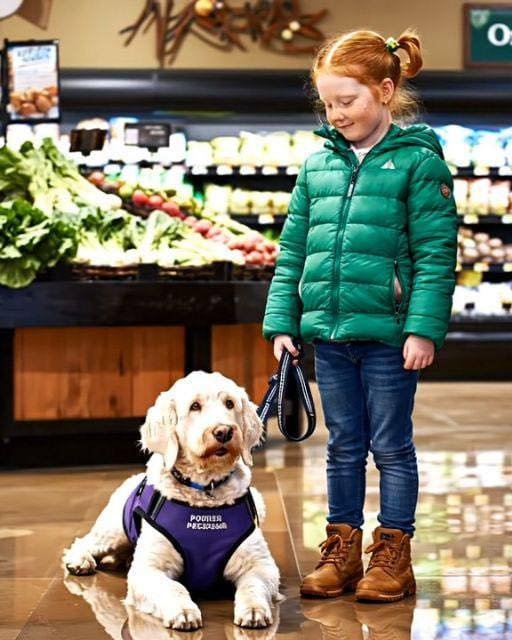
My daughter Miri, eleven years old and wiser than most adults I know, offered to walk ahead with Max, her service dog-in-training. She takes that role with a gravity that belongs to her age. For her, it’s not a chore; it’s a partnership. them.
I was in the cereal aisle, debating the merits of sugary vs. slightly-less-sugary, when I heard the voice — shrill, cutting through the store’s ambient noise like a shard of glass. It was laced with a fury that felt personal, vicious.
I froze, the box of Cheerios suddenly feeling like a lead weight in my hands. I knew that voice wasn’t mine. A cold dread, sharp and immediate, washed over me. Someone was yelling at my daughter.
I abandoned the cart and rounded the corner, my heart pounding a frantic rhythm against my ribs. And I stopped cold.
There she was. A woman, perhaps in her late forties, dressed in pristine yoga pants and a designer workout top that suggested she’d done more shopping than exercising. Her face was a mask of self-righteous fury, her manicured finger — a perfect, glossy red — pointed inches from my child’s face like Miri had committed some unspeakable crime.
“You can’t bring a dog in here unless you’re blind!” she spat, her voice dripping with condescension. “This is a grocery store, not a petting zoo. Where’s your parent? Who lets a kid walk around with a beast like that?!
Miri stood frozen, a small statue under a verbal assault. Her shoulders trembled almost imperceptibly, but her chin was lifted — barely. A defiant flicker in a sea of fear. Her cheeks were flushed a painful shade of red, and her grip on Max’s leash was so tight her knuckles were white. She didn’t cry. My daughter never cries when she’s afraid. She folds inward, building a fortress of calm around herself, hiding behind a wall of Stoicism and hope that the storm will pass.
Max didn’t move. Not a twitch. Not a flinch. He lay there in a perfect down-stay, his body a solid, warm presence at Miri’s feet. His eyes were fixed on the woman, not with aggression, but with a calm, unwavering focus. He knew his real job was happening right now — not in training, not in obedience, but in presence. He was her anchor in a hurricane of judgment.
And then came the final blow, the one that landed like a physical strike:
“Take your mutt and get out. This is why kids shouldn’t be left alone — too entitled to follow the rules.”
Without a word, Miri turned. Her movements were stiff, robotic. She held Max’s leash tight, a lifeline, and walked out of that store with her head high… until she was out of sight. The moment she was past the automatic doors, her posture crumbled.
By the time I caught up, she was outside on a cold concrete bench, trying to force a smile that wouldn’t come, wiping furiously at her eyes like she could erase the tears and the humiliation along with them. But I saw. I felt the tremor that ran through her small frame.
I bent down in front of her, my voice soft but steady, and gently touched her damp cheek.
“You stay here with Max. I’ll be right back.”
And I meant it. Every word.
Because no one gets to humiliate my daughter in public and walk away thinking they were the hero of their own story. Not when my child was doing everything right, following every rule, and bravely navigating a world that isn’t always kind to her.
I stood up, my own fear now replaced by a cold, clear fire.
I walked straight through those automatic doors, whooshing open like a stage curtain.
And what I said next stopped the entire front half of the store.
She was by the self-checkout, waving her receipt like a badge of victory, smirking to herself — until she saw me. The smirk evaporated, replaced by a flicker of annoyance, then unease.
I didn’t yell. I didn’t need to. My voice, when I spoke, was calm and clear, but it carried the weight of a mother’s fury.
“Excuse me,” I said, loud enough for every clerk, shopper, and bystander to hear. A few heads turned. “Do you always harass children with disabilities in public? Or was my daughter just special for you today?”
She turned beet red, the color climbing from her neck to her hairline.
“I—I didn’t know she was—” she stammered, her voice suddenly small and thin. “She looked fine to me.”
“And you decided you got to be the judge of that?” I asked, stepping closer. My voice dropped lower, but it was firm — the kind that made people stop what they were doing and listen. “You saw a child with a working service dog, clearly identified, and instead of thinking your own business, you chose cruelty. You berated an eleven-year-old girl. ELEVEN.”
“She shouldn’t have been alone,” she muttered, fumbling with her purse, desperate for an escape.
“She wasn’t alone. She had Max,” I said, gesturing toward the door. “Who, by the way, behaved with more grace and dignity in that store than you did in your entire life.”
By now, a small crowd had formed, and a store manager with a concerned expression had approached, asking if everything was okay. I explained what happened — every venomous word, every threatening gesture — while she stood there squirming under the bright, unforgiving fluorescent lights.
The manager, his grim face, thanked me and turned to the woman. “Ma’am, I’m going to have to ask you to leave.” She huffed, made one last pathetic attempt to justify herself, then turned and stormed off, eyes avoiding everyone, her victory lap thoroughly ruined.
And I?
I walked back outside, the fire banked but still warm inside me.
Miri looked up, her eyes wide and hopeful, as I sat beside her on the bench. Max immediately rested his head on her lap.
“Did you yell at her?” she asked, her voice barely a whisper.
I smiled, a real smile this time, and wrapped my arms around her shoulders.
“I said what needed to be said. And I made sure everyone heard it.”
She nodded, quietly, leaning into me.
Max leaned into her side, his tail giving a gentle, rhythmic thump against the bench.
And then — finally — Miri let the tears come. Not from fear this time. But from release. From the relief of being seen, of being defended, of being known.
“Thank you,” she whispered into my shoulder.
I held her tight, the scent of her hair filling my senses, and said,
“No one, Miri, no one gets to make you feel small for needing support. Not while I’m breathing.”
Because love doesn’t always show up as softness. Sometimes, it’s a shield. Sometimes, it’s a voice that refuses to be silenced. Sometimes, it stands up in the middle of a grocery store and speaks truth to power, no matter the cost.
For the ones who deserve to be seen. For the children we’re raising to be brave — but never, ever alone.