For years, I dreamed of becoming a mother.
It wasn’t a quiet wish or a passing thought. It was a deep, aching longing that lived in my chest every time I passed a playground, every time I held a friend’s newborn, every time I folded tiny clothes I bought too early and hid in the back of my closet like a secret.
My husband, Daniel, and I tried for eight long years.

Eight years of doctors’ offices that smelled like disinfectant and disappointment. Eight years of needles, charts, whispered conversations, and brave smiles that cracked the moment we got into the car. Eight years of hoping, only to grieve in silence month after month.
And then, when I was almost afraid to believe in miracles anymore, it happened.
I got pregnant.
I remember staring at the test in the bathroom, my hands shaking so badly I had to sit on the floor. When I told Daniel, he cried—really cried, the way I had never seen him cry before.
That night, I called my younger sister Rachel.
She cried even harder than we did.
Rachel wasn’t just my sister. She was my family, my anchor, my best friend. Our parents had died when we were young, and from that moment on, it had been the two of us against the world. We grew up too fast, leaned on each other too hard, and loved each other fiercely.
Two months later, Rachel called me late at night, her voice trembling.
“I’m pregnant too.”
I laughed and cried at the same time. It felt unreal, like life was finally giving us something back after taking so much. Rachel and her husband had wanted a child for years as well, but they’d kept their struggles quiet. Now, suddenly, we were both expecting.
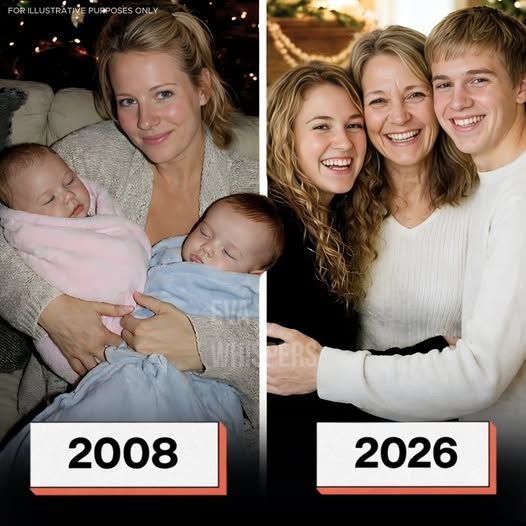
Our pregnancies passed like a shared dream. We compared cravings, swapped baby names, held each other’s hands at appointments. When I gave birth to Emily, my little girl with dark curls and a fierce cry, Rachel was the first person in the room besides Daniel.
Two months later, Rachel gave birth to Noah.
He was a quiet baby, with serious eyes that seemed far too knowing for a newborn. Rachel joked that he was already judging the world.

We raised our children side by side. Sunday dinners. Shared babysitting. First birthdays celebrated together. Emily was emotional and affectionate; Noah was thoughtful, observant, reserved. They were cousins, but they felt more like siblings.
And then, six months later, my world collapsed.
Rachel d.ied in a car accident.
One moment she was calling me to ask about a stroller; the next, I was standing in a hospital hallway that felt impossibly cold, listening to words that didn’t make sense. I remember screaming her name until my throat burned, begging someone to tell me they were wrong.
At the funeral, I held Noah while he slept against my chest, completely unaware that his mother would never hold him again.
Rachel’s husband… vanished.
At first, he said he needed time. He left Noah with me “for a little while,” promising to come back once he got his life together. Days turned into weeks. Weeks into months. Phone calls went unanswered. Messages were never returned.
He never came back.
I was drowning in grief, raising my own infant, and suddenly caring for my sister’s child as well. I barely slept. I barely breathed.
But every time I looked into Noah’s eyes—those same serious eyes Rachel used to joke about—I knew what I had to do.
I filed for guardianship. Then adoption.
Daniel supported me without hesitation. “He’s family,” he said simply.
The day the adoption was finalized, I cried harder than I had in years—not from sadness, but from a quiet promise I made to my sister in my heart: I will love him like my own.
And I did.

Noah grew up kind, intelligent, and thoughtful. He was never loud, never reckless. He asked deep questions, noticed small details. Emily, on the other hand, was expressive and warm, always hugging him, always pulling him into her world.
They fought like siblings, laughed like siblings, grew up as siblings.
And I loved them equally.
Or at least, I thought I did.
Eighteen years passed faster than I ever imagined.
The day after Noah turned eighteen, I was in the kitchen making soup when he walked in. His shoulders were tense. His jaw was clenched so tightly I could see the muscle twitch.
“I’m leaving this house,” he said flatly. “I don’t want you in my life anymore.”
The spoon slipped from my hand and clattered onto the floor.
“Noah,” I whispered, my heart pounding. “What are you talking about?”
He turned to me, and for the first time in his life, I saw real anger in his eyes. Tears burned there too.
“I know the truth,” he said. “This can’t go on anymore.”
I felt dizzy. “What truth?”
He laughed bitterly. “That you’re not my real mother. That you lied to me my whole life.”
The words hit me like a physical blow.
“Noah, I never lied—”
“You let me believe it!” he shouted. “I found the papers. The adoption records. The birth certificate. I wasn’t supposed to find out like that!”
My knees gave out, and I sat down hard in a chair.
“I was going to tell you,” I said, my voice shaking. “I just didn’t know when. I was afraid—”
“Afraid of what?” he snapped. “That I’d hate you? Congratulations. You were right.”
Tears streamed down his face now. “My whole life—I felt different. I felt like something didn’t fit. And you just smiled and pretended everything was normal.”
I stood up, trembling, and walked toward him. “Noah, listen to me. Please.”
“Don’t,” he said, stepping back. “You’re not my mother.”
That word—mother—cut deeper than anything I had ever known.
“I loved you from the moment I held you,” I said softly. “I chose you. Every day.”
He shook his head. “You chose a replacement. I was just… convenient.”
That broke me.

I told him everything then. About Rachel. About the accident. About the man who left him behind. About the promise I made to my sister. About how I loved him not out of obligation, but out of devotion.
He listened in silence, his face unreadable.
When I finished, he picked up his bag.
“I need time,” he said. “I can’t be here.”
And then he walked out.
The days that followed were the longest of my life. Emily cried. Daniel barely spoke. I replayed every moment of Noah’s childhood, wondering where I had failed.
Three months passed.
Then one evening, there was a knock on the door.
Noah stood there, thinner, tired, eyes softer.
“I went to see her grave,” he said quietly. “Rachel.”
I nodded, unable to speak.
“She was your sister,” he continued. “But she was my mother. And you… you were the one who stayed.”
He swallowed hard. “I was angry because it hurt. Not because I didn’t love you.”
I opened my arms, unsure.
He stepped into them.
For the first time in months, I breathed.
“I know the truth now,” he whispered. “And I’m still here. If you’ll let me be.”
I held him like I had when he was six months old—like I always would.
Because motherhood isn’t only about blood.
Sometimes, it’s about never letting go.