The biker noticed her long before she even sensed someone was watching.
She stood stiffly beside a faded sedan with the gas cap dangling open, an empty tank blinking like an emergency signal. Her hands trembled around a pile of coins—pennies, nickels, a few dimes—held so tightly they left little crescent marks in her palms. She kept counting them, then recounting them, as if the numbers might magically change.
Her mascara had run in two dark streaks down her cheeks. She wasn’t crying anymore—she had moved past crying and into that silent, fragile state where every breath feels stolen. Her shoulders were slumped inward, like she was trying to become smaller, less noticeable, less… anything.
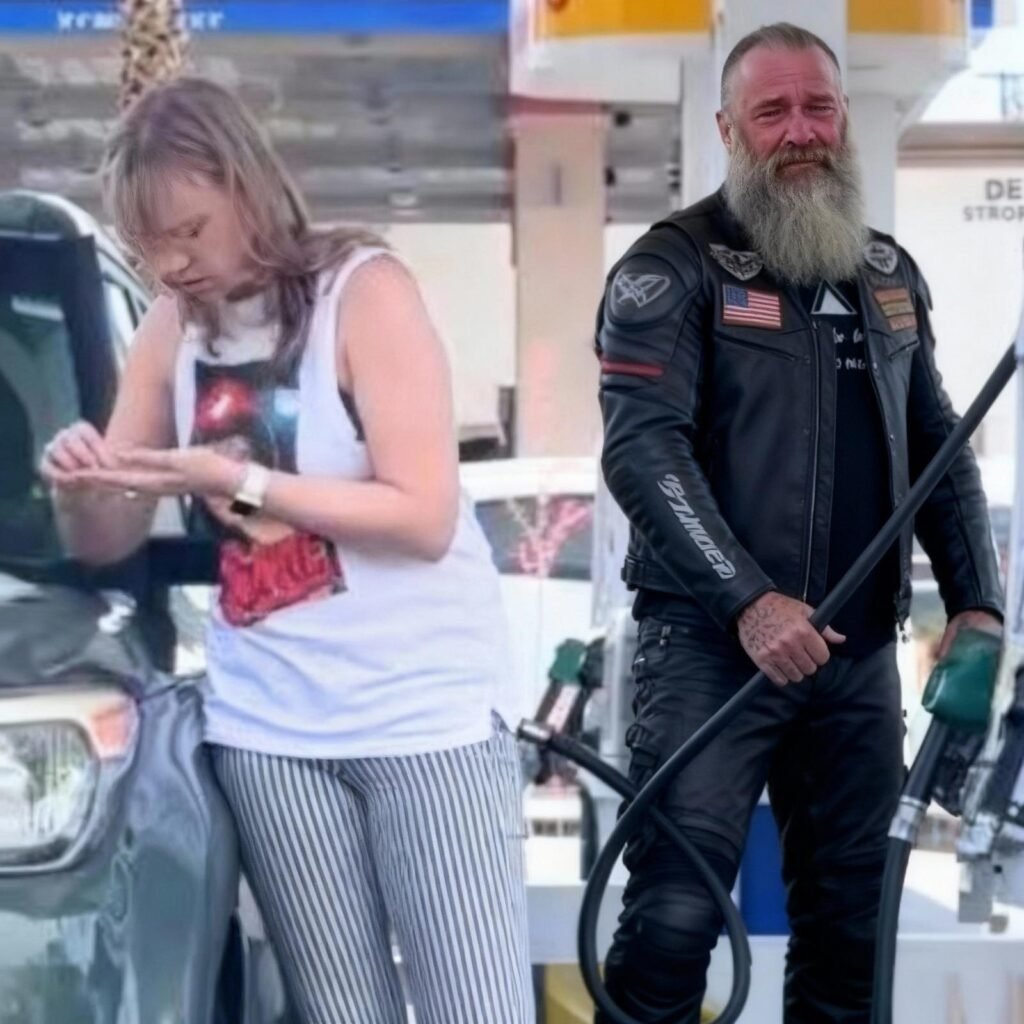
The biker knew that look. He’d seen it before—on strangers at bars, on kids in alleyways, on soldiers who came home but never really came home.
It was the look of someone bracing for something.
He kept his distance at first, but when she tried to pay with the coins—her voice barely audible, hand shaking so badly the cashier couldn’t even count them—he stepped forward quietly and said, “I’ve got it.”
Her reaction wasn’t gratitude.
It was fear.
“Please don’t,” she whispered, panic rising so sharply it cut right through the noise of the station. “If he sees… he’ll think I asked you. He’ll get furious. Please.”
Her eyes darted to the convenience store window like she expected something awful to burst through it any second. And in that single trembling moment, the biker understood this wasn’t about gas money. This was about survival.
He nodded gently and said nothing more.
Just walked out, picked up the nozzle, and filled her tank himself.
She stood frozen, hands trembling against her chest, watching him like she expected the world to explode.
It nearly did.
As he clicked the pump off, the store door slammed open.
Out stormed the boyfriend—face tight with anger, jaw clenched, steps so heavy they seemed to shake the ground. His voice rose before he’d even crossed the parking lot, accusations flying, demanding to know who this man was, what she had said, what she had done.
The biker didn’t flinch.
But the girl did—she shrank backward as if trying to disappear. Her breath hitched, her fingers curled, and her eyes filled with the kind of dread that made the biker’s stomach twist.
And then, in the smallest voice he’d ever heard, she said it:
“Help me.”
Two words.
Two words that carried months of terror.
The biker reached for his phone. The boyfriend lunged forward. And just then—like fate had been waiting on the other side of the block—the police cruiser rolled in. Officers saw her expression, saw the bruises she’d stopped hiding, saw the rage boiling off the boyfriend, and stepped in before anything else could happen.
For the first time in a long time, she wasn’t alone.
She wasn’t disbelieved.
She wasn’t trapped.
She was safe.
At the shelter that night, she found more than a warm bed. She found people who listened. People who understood. People who didn’t look away when she described the isolation, the threats, the erosion of her freedom piece by piece until she felt more like an object than a human being.
She didn’t expect the biker to think about her again.
But two weeks later, he received a letter—handwritten, shaky, but filled with something he hadn’t seen in her eyes that day: hope.
She wrote that she had gone home.
That her mother had cried and held her as if afraid she’d vanish again.
That she’d enrolled in school—a step she thought she’d never be allowed to take.
“You didn’t just help me,” she wrote.
“You reminded me I mattered.”
Years passed.
One afternoon, he received another envelope. Inside was a photo: her standing next to her very first car, beaming, holding the keys, the dashboard lit up with a full tank of gas she paid for herself. She wrote that she now worked with a nonprofit that helps others escape the same darkness she once lived through.
The biker folded the letter, tucked it into his wallet, and kept it there—creased, worn, reread a hundred times. Not because he needed the thanks, but because it reminded him of something rare and powerful:
Sometimes, courage isn’t loud.
Sometimes, it’s a trembling whisper at a gas pump.
Sometimes, it’s a stranger taking one small step forward when everyone else steps back.
And sometimes, one simple act of kindness becomes the spark that saves a life.